
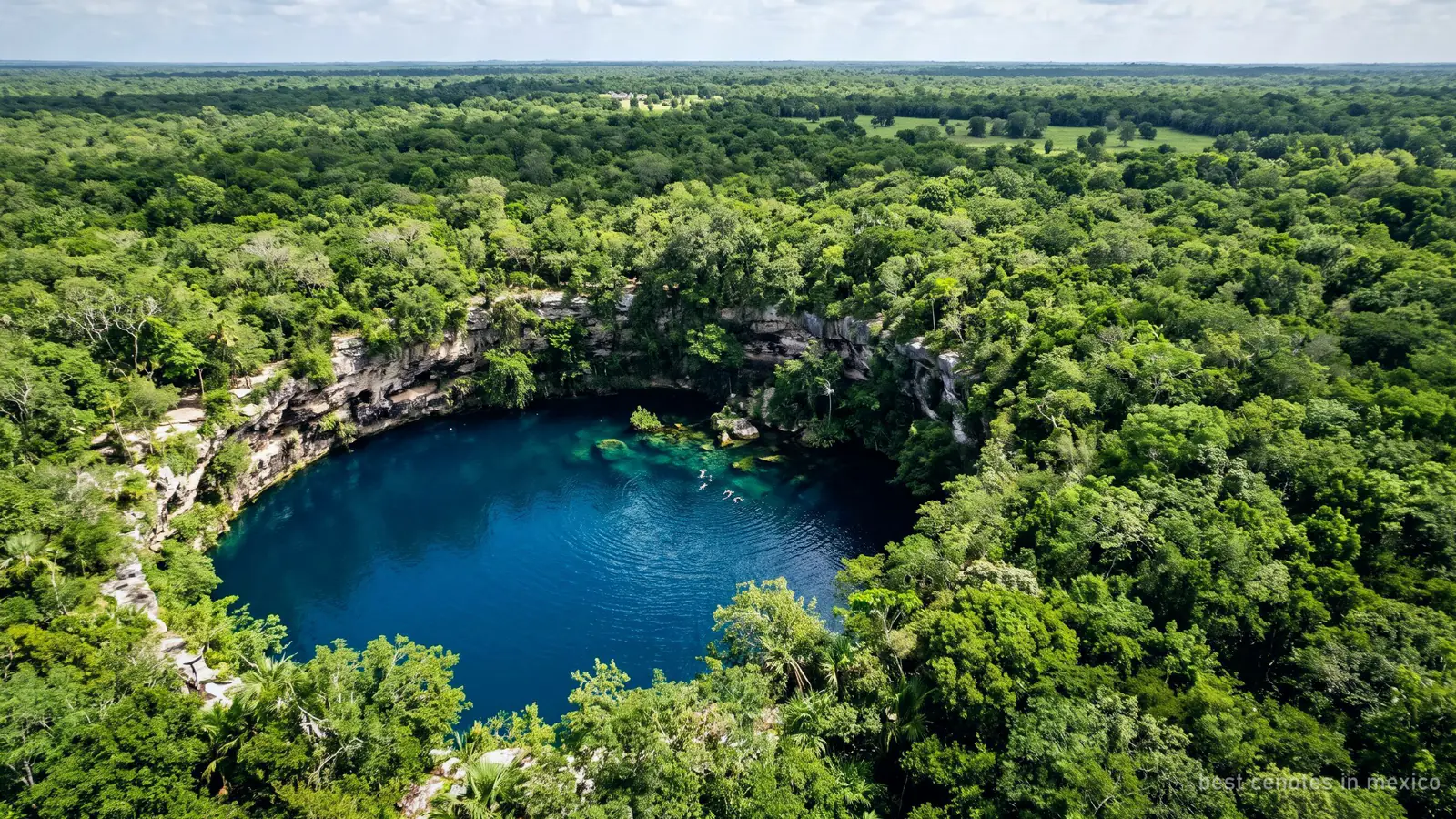
Best Cenotes in Mexico: 11 Picks, Nearest to Cancún First
Updated October 27, 2026
Almost all of Mexico's cenotes are on the Yucatán Peninsula, split mainly between the states of Quintana Roo (Cancún, Playa del Carmen, Tulum) and Yucatán (Valladolid, Chichén Itzá, Mérida). Nobody has counted them all. Wikipedia cites an estimate of about 10,000 for the peninsula; Yucatán state has 3,050 cenotes on record with its environment ministry against an estimate of 7,000 to 8,000 (Por Esto, 2026); and Por Esto reported more than 3,500 in Quintana Roo in 2025, without an official source. There are so many because the peninsula is a flat slab of limestone with no rivers in the north: rain dissolves the rock into caves, and a cenote forms when a cave roof collapses onto the groundwater. In Yucatán state a ring of cenotes traces the rim of the Chicxulub crater, left by the asteroid impact 66 million years ago. This list picks the cenotes with the most to show, one or two per area, ranked by distance from Cancún, nearest first, because that is where most visitors start: from the Ruta de los Cenotes 36 km south of the city to Chichén Itzá 200 km inland, with Zacatón, on the other side of Mexico, last. Each entry gives the type, the fee in Mexican pesos (MXN) and what it is for. For the day trips that reach them, see the best cenotes near Cancún and the cenote tours from Cancún.
- #1
Cenote Zapote and the Hells Bells, Puerto Morelos
Bell-shaped rocks at 30 m that grow down to the salt water.
An open shaft over a large cavern on the Ruta de los Cenotes, about 36 km south of Cancún. Zapote is 54 m deep, and between 29 and 35 m hang the Hells Bells: hollow carbonate formations up to 2 m long that stop growing at the halocline, where fresh water meets salt water. Dating shows they began forming more than 5,200 years ago and are still growing; the first papers on them came from Heidelberg University in 2018 and 2019. Swimmers get two open cenotes, a cavern, jumps and a water zip line; the bells are for certified divers only, and two guided dives with Cancún pickup cost from $215. The swim fee is paid at the gate.
-
 #2
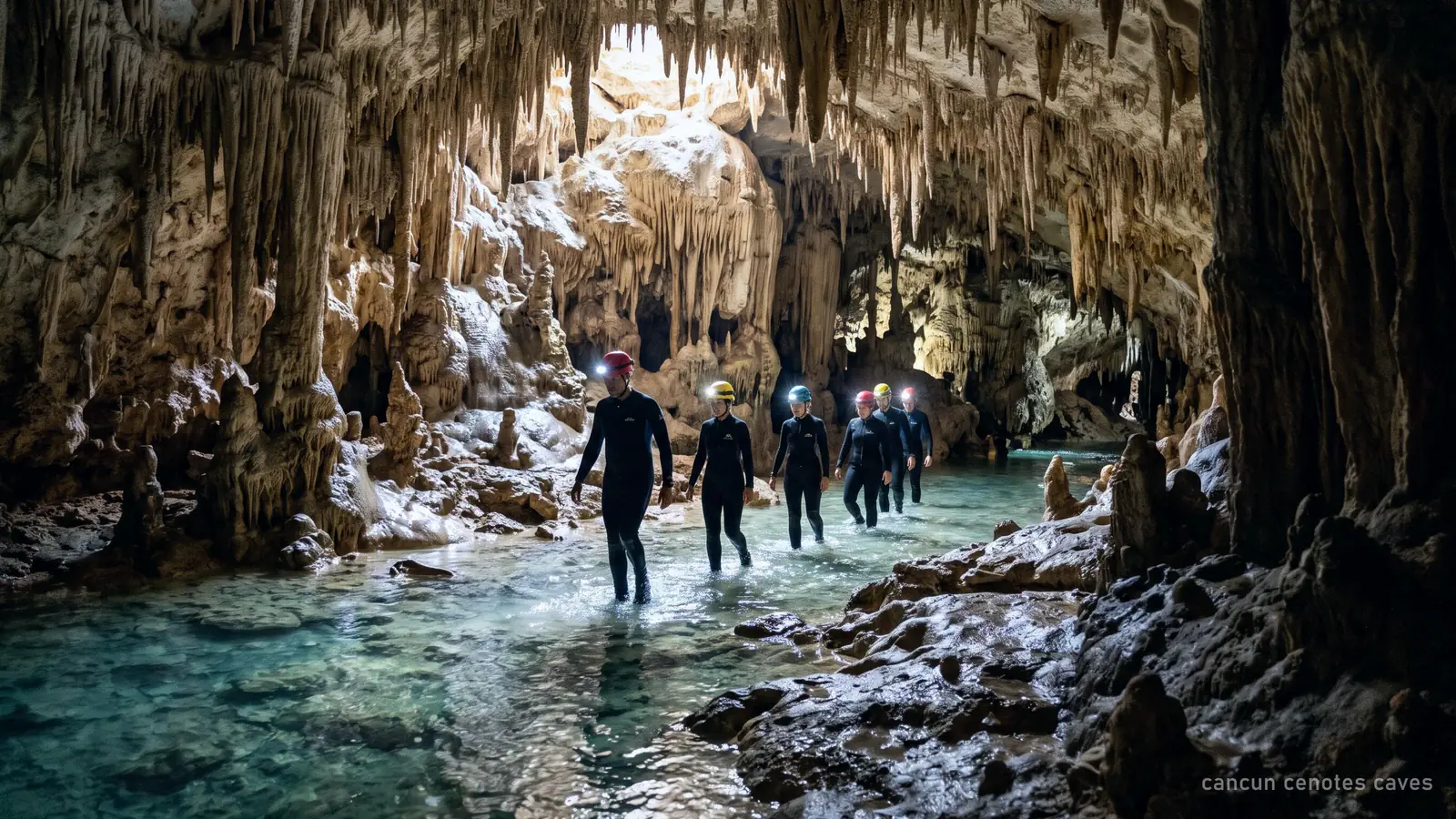
Río Secreto, Playa del Carmen
$119An underground river you walk and float through with a guide.
4.6 201 reviews
A cave reserve at km 283.5 of Highway 307, near Playa del Carmen, about 68 km from Cancún. Found in 2004 and opened in 2008, it has 38 km of caves, about 10% used for guided tours: about 1 km underground on the Classic route, walking and floating in water of 22 to 24 °C under stalactites, with wetsuit, helmet and lamp. Official price from USD 89 without transport, USD 119 with transport from Cancún. The underground river tour is from $119 with pickup, rated 4.6 on 201 reviews of this tour on GetYourGuide. It suits non-divers who want to go inside a cave system.
Check availability Read the full page Open in Maps Wikipedia
- #3
Cenote Dos Ojos, Tulum
The entrance to one of the longest flooded cave systems on Earth.
A cavern cenote about 117 km from Cancún, 20 km north of Tulum. Dos Ojos is two cenotes that open into one cavern; its own cave system, 82 km surveyed, was linked to Sistema Sac Actun in 2018, and Sac Actun measured 386 km including dry passages in January 2023, second only to nearby Ox Bel Ha. The Pit, in the same system, is the deepest known cave passage in Quintana Roo at 119.1 m. Snorkellers pay 350 to 500 pesos (2026 reports) for an area about 10 m deep, life jacket mandatory. It suits snorkellers and cavern divers.
- #4
Gran Cenote, Tulum
Where the exploration of Sac Actun began, and the easy Tulum snorkel.
A semi-open cenote 4 to 5 km from Tulum on the road to Cobá, about 120 to 130 km from Cancún. Cave divers started surveying Sistema Sac Actun here. Today Gran Cenote has two pools joined by tunnels along a boardwalk, with small turtles in the water and bats on the cavern ceiling; the water stays at about 25 °C all year, a 2026 guide says. Entry is about 500 pesos (2026 reports), cash; shower first, no sunscreen. Go at the 8:00 opening, as parking fills by mid-morning. It suits snorkellers and families with confident swimmers. More in cenote Tulum.
- #5
Cenote Zací, Valladolid
A cenote in the middle of a colonial town.
A semi-open cenote a few blocks from the main square of Valladolid, about 158 km and 2 hours from Cancún. It was the water supply of the Maya settlement, Zací, that stood here before the Spanish founded Valladolid in 1543. Stairs cut into the rock lead down to a cave about 150 feet across; Wikipedia gives the water as 100 m deep at its deepest. The town council set the fee at 150 pesos for adults and 75 for children in January 2025. It suits anyone on a Chichén Itzá day or staying in Valladolid. See Zací and the cenotes near Valladolid.
- #6
Cenote Suytun, Valladolid
The most photographed platform in Yucatán, under a single skylight.
A cave cenote 8 km east of Valladolid, about 164 km from Cancún. A stone walkway crosses the water to a round platform directly under the one opening in the vault, and from late morning to early afternoon a beam of light falls on it; that is also when the queue is longest. The water is shallow, 1 to 5 m, so state tourism says non-swimmers can bathe, with a life jacket. Reports from 2025 give 120 to 250 pesos, cash. It suits photographers more than swimmers. See Cenote Suytun.
- #7
The Sacred Cenote, Chichén Itzá
The cenote of offerings and sacrifice, seen from the rim.
An open cenote about 60 m across inside the Chichén Itzá archaeological zone, about 202 km from Cancún, joined to the civic centre by a 300 m raised causeway; its cliffs drop about 27 m to the water. Maya and Spanish sources say the Maya offered valuables and people to the rain god Chaac here. Dredging from 1904 brought up gold, jade, copal, pottery, textiles and human remains, many shipped to Harvard's Peabody Museum. You cannot swim in it: visitors view it from the rim, as part of the 697-peso Chichén Itzá ticket for foreigners (INAH, since March 2026). See the Sacred Cenote.
- #8
Cenote Ik Kil, near Chichén Itzá
A 48 m deep open cenote with vines hanging to the water.
An open cenote 3 km from Chichén Itzá and about 203 km from Cancún. Ik Kil is about 48 m deep and 60 m across, with the water about 26 m below ground; a stairway cut through the rock leads down to a swimming platform, and lifeguards are on duty. It is one of few cenotes with an official price: 240 pesos for adults and 150 for children, life vest, locker and parking included, open 9:00 to 17:00 every day. Tour buses tend to arrive after 11:30, one visitor found. It suits anyone pairing a swim with the ruins.
- #9
Cenote Yokdzonot, Yaxcabá
A community-run open cenote with rappel and zip line.
An open cenote with vertical walls, about 25 minutes by road beyond Chichén Itzá. State tourism gives it as 131 ft across and 147 ft deep. The Zaaz Koolen Haá cooperative of Yokdzonot village began restoring the abandoned cenote in 2005 and runs it today, with a restaurant, camping platforms and sacbé paths. A November 2025 report gives 200 pesos for foreigners and 100 for Mexicans, plus 100 pesos each for the zip line or an 18 m rappel. It suits travellers with a car who want a big open cenote run by its village.
- #10
The cenotes of Homún, Yucatán
One village, about 300 cenotes, about 30 open to visitors.
Homún, a village in Yucatán state, beyond Chichén Itzá on the Mérida side of the peninsula, has about 300 cenotes, roughly 30 of them open to the public, according to Yucatán Today (January 2026). Visitors go from one cenote to the next by mototaxi, at about 300 pesos per person for up to four people, or by buggy at about 1,600 pesos per vehicle (secondary reports); each cenote charges its own entry at the gate. It suits travellers based in Mérida who want several small cenotes in one day.
- #11
El Zacatón, Tamaulipas
One of the deepest water-filled sinkholes known, at 339 m.
Far from the Yucatán, in Aldama municipality, Tamaulipas, in northeast Mexico. Zacatón has a total depth of 339 m: about 20 m from the rim to the water and 319 m under it, measured by an autonomous robot in the NASA-backed DEPTHX project. Wikipedia calls it one of the deepest known water-filled sinkholes in the world, not the deepest. It is not a cenote you visit from Cancún, and we found no visitor fee, but it answers the question of the deepest cenote in Mexico. For depths closer to Cancún: The Pit at Dos Ojos, 119.1 m, and Zací, about 100 m.
Frequently asked questions
How many cenotes are there in Mexico?
There is no official national count. Wikipedia cites an estimate of about 10,000 for the Yucatán Peninsula, and a weaker one of at least 6,000. Yucatán state has 3,050 cenotes on record with its environment ministry, against an estimate of 7,000 to 8,000 (Por Esto, 2026); the state census cited in its 2014 decree counted 2,241, of which 1,014 open, 734 closed, 342 semi-open and 151 caves. Quintana Roo has more than 3,500, Por Esto reported in 2025.
Where are the cenotes in Mexico?
Almost all are on the Yucatán Peninsula, in the states of Quintana Roo and Yucatán. On the Caribbean side they cluster on the Ruta de los Cenotes near Puerto Morelos and along Highway 307 from Playa del Carmen to Tulum. Inland they cluster around Valladolid, Chichén Itzá and Homún. See the best cenotes near Cancún for the ones within a day trip.
Why does Mexico have so many cenotes?
The Yucatán Peninsula is about 181,000 km² of flat limestone with no rivers above ground in the north. Rainwater, made slightly acidic by carbon dioxide, dissolves the rock into caves, and a cenote opens where a cave roof collapses. Sea level was about 120 m lower 20,000 years ago, so many caves were dry and later flooded. In Yucatán state, cenotes line up in a ring over the rim of the Chicxulub impact crater. More in how cenotes are formed.
What is the deepest cenote in Mexico?
El Zacatón in Tamaulipas reaches 339 m, 319 m of it under water, and Wikipedia calls it one of the deepest known water-filled sinkholes. On the Yucatán Peninsula, The Pit in the Dos Ojos system reaches 119.1 m, the deepest known cave passage in Quintana Roo, and Zací in Valladolid is about 100 m at its deepest. Ik Kil is about 48 m and Zapote 54 m.
Are there cenotes outside Mexico?
Yes, cenote-like sinkholes exist elsewhere. Wikipedia lists Ewens Ponds and Little Blue Lake in South Australia, Thunderball Grotto in the Bahamas, Hoyo Azul in the Dominican Republic, and Montezuma Well in Arizona and the Blue Hole of Santa Rosa in New Mexico, among others. The word cenote itself comes from the Yucatec Maya ts'ono'ot. See what a cenote is.
Can you swim in the Sacred Cenote at Chichén Itzá?
No. Visitors may only view it from the rim. To swim on a Chichén Itzá day, go to Ik Kil, 3 km away, or take the Chichén Itzá day with a cenote swim, which swims at Chichikán near Valladolid: from $57, rated 4.6 on 8,731 reviews of this tour on GetYourGuide, free cancellation up to 24 hours before.
Which of Mexico's best cenotes can I reach from Cancún in a day?
All on this list except Homún, which suits a base in Mérida, and Zacatón. The Ruta de los Cenotes starts about 30 minutes south at Puerto Morelos, Playa del Carmen and Tulum one to two hours, Valladolid and Chichén Itzá two to two and a half hours. Tours from Cancún are compared on the tours page, with prices from $39 to $119 for the six we recommend.
Sources