
The Sacred Cenote of Chichén Itzá: History, Depth, Visit
Updated October 27, 2026
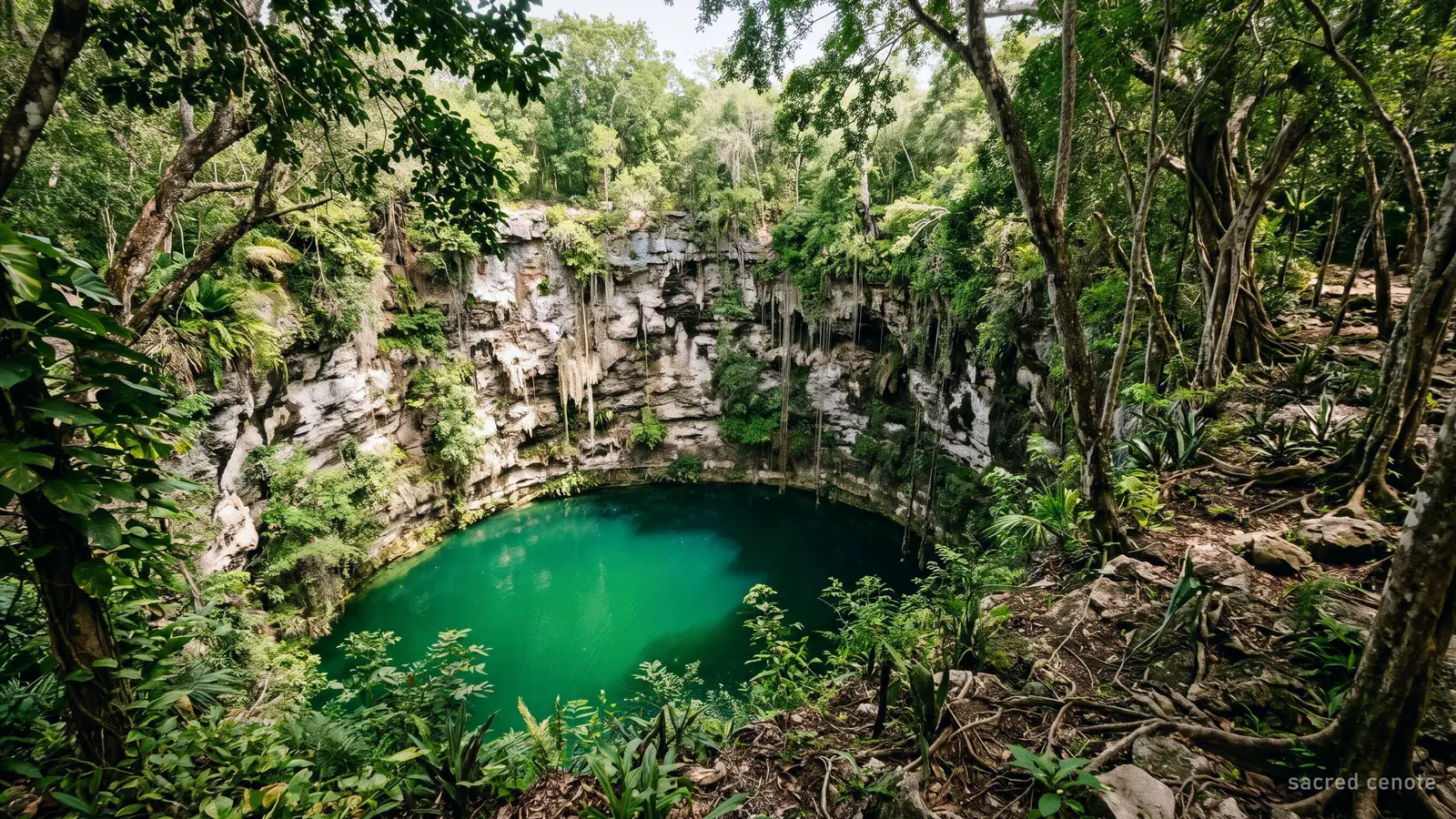
The Sacred Cenote (Cenote Sagrado) is the large open sinkhole inside the Chichén Itzá archaeological zone in Yucatán, joined to the centre of the site by a 300 m raised causeway. It has no separate fee: you see it on the Chichén Itzá ticket, 697 pesos (MX$697) for foreign visitors under the single ticket in force since 27 March 2026 (INAH). You cannot swim in it; visitors view it from the rim. The swim most Chichén Itzá visitors take is at Cenote Ik Kil, 3 km away.
Where the Sacred Cenote is in Chichén Itzá
The cenote lies north of the pyramid of Kukulcán (El Castillo). A raised stone road, a sacbe of about 300 m (980 ft), links it to the civic precinct (Wikipedia); Showcaves gives about 350 m from the pyramid. It is not the only cenote on the site: Xtoloc, overlooked by the Temple of Xtoloc, is the second largest. The zone opens daily from 8 a.m. to 5 p.m., with last entry at 4 p.m. and clearing from 4:30 p.m. (INAH).
- Foreign visitors, 697 pesos — Single ticket since 27 March 2026: 105 pesos federal INAH fee plus 592 pesos Yucatán state fee (INAH; Diario de Yucatán).
- Mexican nationals, 310 pesos — Yucatán residents pay only the 105-peso INAH fee; nationals enter free on Sundays.
- Parking, 124 pesos — Cars, vans and buses from 1 May 2026 (Diario de Yucatán).
How big and how deep is the Sacred Cenote?
The cenote is about 60 m (200 ft) across, and its sheer walls drop to the water about 27 m (89 ft) below the rim (Wikipedia; Showcaves gives 56 m across). The sources we read do not publish the depth of the water itself. In 1967 and 1968 an expedition led by Norman Scott and Román Piña Chán pumped out about 4 m (13 ft) of water to reach objects on the bottom.
What was found in the Sacred Cenote
Maya and early Spanish sources say the Maya threw valuables and human bodies into the cenote as offerings to Chaac, the rain god. Dredging proved it. Objects recovered include gold, jade, copal incense, pottery, flint, obsidian, shell, wood, rubber and cloth; jade is the largest group, then textiles (Wikipedia). The human remains include men, women and young children. A study of some of them found wounds consistent with sacrifice, though whether the remains show sacrifice is still debated. The Peabody Museum at Harvard holds nearly 30,000 objects from the cenote, and several jade and gold works have been returned to Mexico (New York Review of Books, 2022). More on what cenotes were used for.
- 1904 — Edward H. Thompson, funded by Stephen Salisbury III, starts dredging with a bucket on a pulley; sources end the work anywhere from 1907 to 1911.
- 1909 — Thompson dives to the floor and reports gold objects, jade and copper bells; most finds are shipped to the Peabody Museum.
- 1961 — INAH, the National Geographic Society and CEDAM recover a gold-sheathed bone, a chert knife with a gold-sheathed handle and jade and turquoise ear flares.
- 1967–1968 — Norman Scott and Román Piña Chán lower the water by about 4 m.
Can you swim in the Sacred Cenote?
No. Entering the cenote is forbidden, and visitors may only look at it from the rim (Showcaves). It sits inside a federal archaeological zone run by INAH, and the walls drop 27 m straight to the water. We found no INAH page that states the reason in its own words, so we leave it at the rule.
Where to swim near Chichén Itzá instead
The nearest swimming cenote is Cenote Ik Kil, 3 km away: an open cenote about 48 m deep, 240 pesos for adults with life vest, locker and parking, open 9 a.m. to 5 p.m. (park website). Valladolid, about 42 km east, has Cenote Zací in the town centre (150 pesos for adults since January 2025) and Cenote Suytun, a cave cenote 8 km out of town.
Seeing it on a tour from Cancún
Chichén Itzá is about 202 km from Cancún, about 2.5 hours by car. The Chichén Itzá and cenote tour from Cancún we list, run by Amigo Tours LATAM, is a 12-hour day from $57 with a certified guide through the ruins, a swim at Cenote Chichikan and a panoramic stop in Valladolid. It scores 4.6 on 8,731 reviews of this tour on GetYourGuide. The listing says the archaeological-site fee is paid on the day unless you book the All-Inclusive option. Pickup is from your hotel or a meeting point depending on the option, with free cancellation up to 24 hours before. Other Chichén Itzá days are compared on our cenote tours page.
INAH: Chichén Itzá archaeological zoneSacred Cenote on WikipediaChichén Itzá on Wikipedia
Frequently asked questions
Can you swim in the Sacred Cenote at Chichén Itzá?
No. Entering it is forbidden and visitors view it from the rim. The nearest cenote you can swim in is Ik Kil, 3 km away.
How deep is the cenote at Chichén Itzá?
The walls drop about 27 m (89 ft) from the rim to the water, and the cenote is about 60 m across (Wikipedia). The sources we read do not give the depth of the water.
Is there a fee to see the Sacred Cenote?
Not a separate one. It is inside Chichén Itzá, so the site ticket covers it: 697 pesos for foreign visitors and 310 pesos for Mexican nationals in 2026 (INAH).
Is there a cenote near Chichén Itzá you can swim in?
Yes. Cenote Ik Kil is 3 km from the ruins and costs 240 pesos for adults, life vest and locker included. Valladolid's Zací and Suytun are about 40 to 50 km east.
What was found in the Sacred Cenote?
Gold, jade, copal, pottery, flint, obsidian, shell, wood, rubber, cloth and human remains. The Peabody Museum at Harvard holds nearly 30,000 objects from it.
Sources