
What were cenotes used for?
Updated October 27, 2026
Quick answer
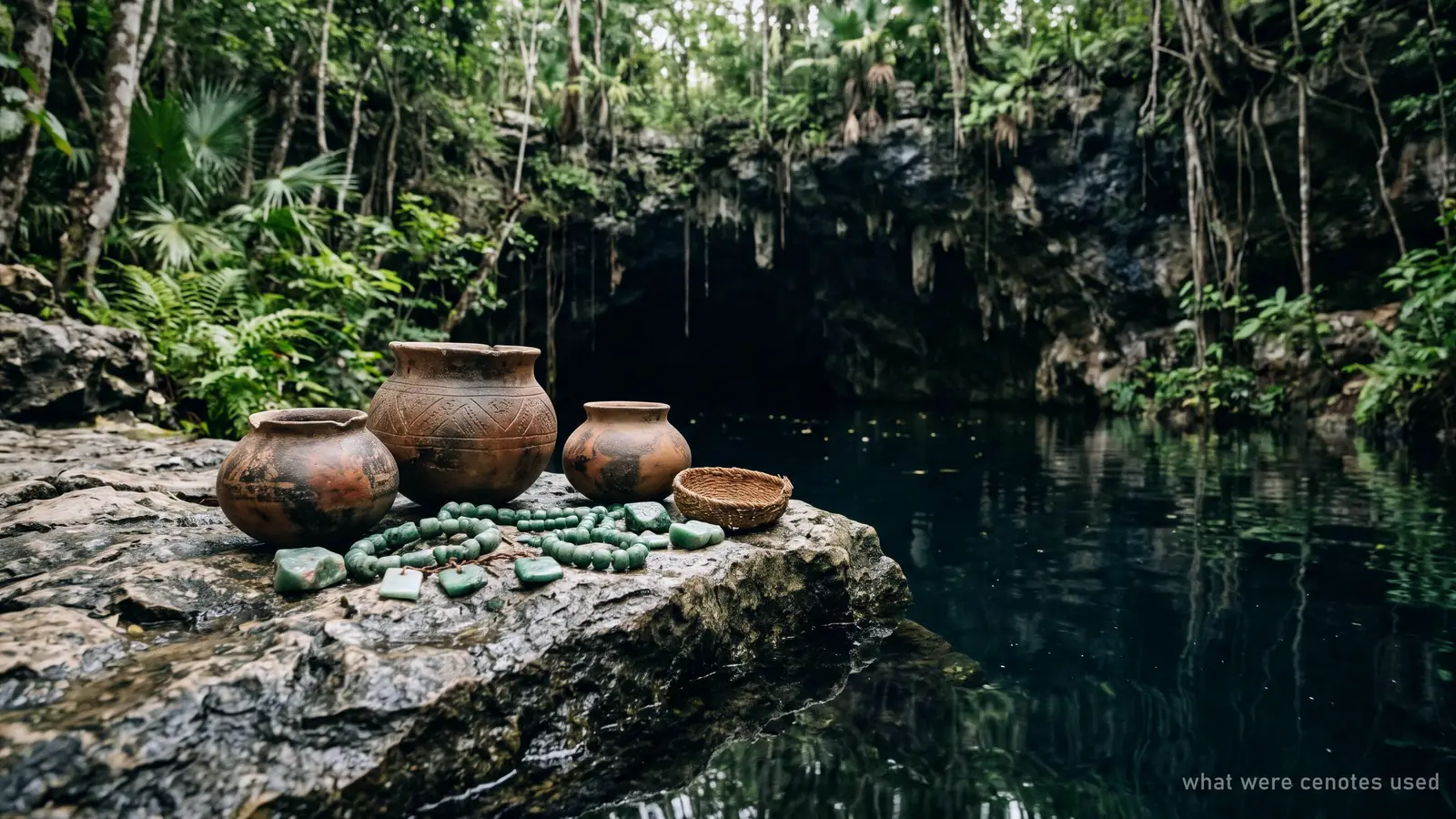
Water first, then religion. The northern Yucatán has no rivers above ground, so cenotes were the main source of water, and cities such as Chichén Itzá grew up around them. The Maya also saw them as entrances to Xibalba, the underworld, and as homes of the rain god Chaac, and they left offerings in them: jade, gold, pottery, copal and, at some cenotes, human remains.
The word itself is Maya: cenote comes from the Yucatec Maya ts'ono'ot (also written tz'onot), used for any place with reachable groundwater. Por Esto (2022) glosses it as 'deep thing' or 'abyss', and notes that cenote water was treated as 'virgin water' (suhuy ha'). Not every cenote was sacred in the same way: at Punta Laguna none of the roughly 120 people whose remains were studied showed signs of sacrifice (Wikipedia). The best-known ritual cenote is the Sacred Cenote at Chichén Itzá.
Water supply
The Yucatán Peninsula is a flat limestone plain of about 181,000 km², and its northern half has no rivers on the surface; rain sinks into the rock and flows underground (Wikipedia). Cenotes were the open windows onto that water. Where there were none, as in the Puuc hills, the Maya dug chultunes, bottle-shaped cisterns with plastered aprons that caught rainwater. Today the same aquifer is still the peninsula's only source of fresh water (Perera-Burgos et al., 2024), which is why the swimming rules on what to wear to a cenote ban sunscreen before the swim.
Xibalba, Chaac and the dead
Xibalba is the K'iche' Maya name for the underworld, roughly 'place of fright'; the Yucatec Maya called it Mitnal. In the Popol Vuh it is ruled by death lords and defeated by the Hero Twins (Wikipedia). An INAH bulletin (number 629, 25 November 2025) says cenotes and flooded caves are widely tied in Maya culture to the underworld and to the path of the souls of the dead to Xibalbá, that funerary use reaches back to prehistory, and that a colloquial Yucatec Maya way to say someone died translates as 'entered the water'. Remains in Quintana Roo caves are very old: the Eve of Naharon skeleton was dated to about 13,600 years, and Naia, a teenage girl found in Hoyo Negro near Tulum, lay at 43 m.
Offerings and sacrifice at the Sacred Cenote
Chichén Itzá's Sacred Cenote is about 60 m (200 ft) across, with sheer walls dropping about 27 m (89 ft) to the water, linked to the main plaza by a raised causeway about 300 m long (Wikipedia). Maya and Spanish sources say offerings and human bodies were given to Chaac there; Bishop Diego de Landa wrote in 1566 that people were thrown in alive during droughts.
- Thompson's dredging — Edward Herbert Thompson began dredging in 1904. Sources disagree on when he stopped: 1907 (Showcaves), 1910 (Wikipedia's Chichén Itzá page), 1911 (New York Review of Books, 2022), and 'officially done by 1923' (Wikipedia's Sacred Cenote page). He shipped most finds to Harvard's Peabody Museum, which holds nearly 30,000 objects from the cenote; some jade and gold pieces have been returned to Mexico.
- Later expeditions — INAH, the National Geographic Society and CEDAM worked the cenote in 1961, and Norman Scott and Román Piña Chán lowered the water by about 4 m in 1967 and 1968.
- What came up — Gold, jadeite, copal, pottery, flint, obsidian, shell, wood, rubber and cloth; jade is the largest group, followed by textiles (Wikipedia).
- The human remains — Men, women and young children, many of them aged about 6 to 12 (Wikipedia). Estimates of how many differ, from about 50 skeletons removed by Thompson (Showcaves) to the bones of about 200 people overall (Royal Resorts). Some show wounds consistent with sacrifice, but whether the remains prove sacrifice is still debated.
Visit one
You cannot swim in the Sacred Cenote; visitors see it from the rim, and it is covered by the Chichén Itzá ticket, 697 pesos (MXN) for foreigners in 2026 (INAH). Chichén Itzá also has a second cenote, Xtoloc, overlooked by its own temple. To swim in a cenote the same day, Ik Kil is 3 km away at 240 pesos. See Chichén Itzá's cenotes on a day tour: a guided visit to the ruins, a swim at Cenote Chichikán and a stop in Valladolid, from $57 plus the site fee, rated 4.6 on 8,731 reviews of this tour on GetYourGuide. The Sacred Cenote page covers the site itself.
Frequently asked questions
Were cenotes used for human sacrifice?
Some were. Maya and Spanish sources describe offerings of people at Chichén Itzá's Sacred Cenote, and some remains there show wounds consistent with sacrifice, though scholars still debate it. At Punta Laguna, none of about 120 people studied showed signs of sacrifice.
Why were cenotes important to the Maya?
They were the main water source in a region with no surface rivers, so cities grew around them. They were also sacred: entrances to Xibalba and homes of the rain god Chaac.
What does the word cenote mean?
It comes from the Yucatec Maya ts'ono'ot, a place with reachable groundwater. Por Esto glosses it as 'deep thing' or 'abyss'.
Where did the Sacred Cenote's treasures go?
Most of Edward Thompson's finds went to Harvard's Peabody Museum, which holds nearly 30,000 objects from the cenote. Some jade and gold works have been returned to Mexico (New York Review of Books, 2022).
Can you see the Sacred Cenote on a Cancún day trip?
Yes, it is inside Chichén Itzá, about 200 km from Cancún. You view it from the rim; swimming is not allowed. Day tours from Cancún take about 12 hours.
Sources