
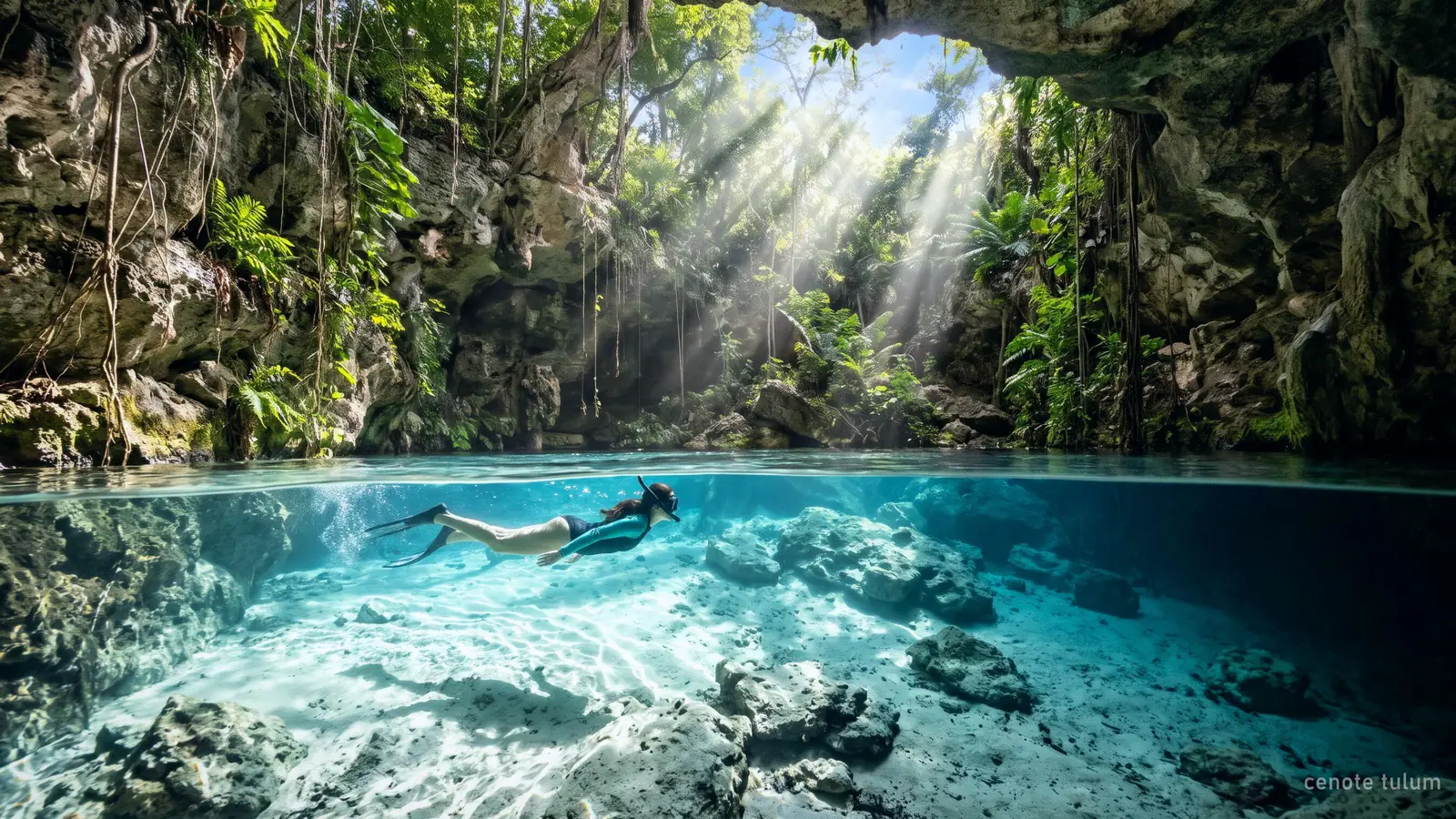
Cenote Tulum: 12 Cenotes Near Tulum, Nearest First, With Fees
Updated October 27, 2026
Tulum sits on top of one of the longest flooded cave systems known: Sistema Sac Actun alone has 228 cenote entrances, according to its Wikipedia entry, and nobody publishes a count for the town as a whole. This list covers the 12 that visitors actually go to, ranked by distance from downtown Tulum, nearest first: from Calavera, 3 km out on the road to Cobá, to the Cobá cenotes about 45 minutes inland. Each entry gives the type (open, semi-open or cave), the gate fee in Mexican pesos (MXN), what it is best for and who it suits. No Tulum cenote publishes an official price list, so every fee here comes from a dated travel report, and where reports disagree we give the range. Pay in cash. From Cancún, Tulum is about 120 to 130 km down Highway 307. The ADO bus costs 136 to 365 pesos (Por Esto, 2026) and takes about 2.5 hours; the Tren Maya takes 1 h 32 to 1 h 43. Most of the cenotes below are on two roads out of town: the road to Cobá and Highway 307 north toward Playa del Carmen. To do the ruins and a swim in one day, every cenote tulum day trip from Cancún is compared on our tours page.
- #1
Cenote Calavera
Three holes in the ground, and you jump in through one of them.
Semi-open, about 3 km from the centre on the Tulum–Cobá road. Calavera is named for its three round openings, which from above look like a skull; you drop through holes about 12 m and 8 m deep into the water below. 2026 reports give 150 to 300 pesos, cash; one blog lists a USD 15 charge for filming with a GoPro. A life jacket is not compulsory here, and the rock steps are slick. A colectivo toward Cobá costs about 30 to 40 pesos and drops you near the gate. It suits confident swimmers and jumpers more than families.
- #2
Cenote Cristal and Cenote Escondido
Two open cenotes on one ticket, joined by an underwater passage.
Open cenotes about 4 km south of town on Highway 307, on either side of the road. Cristal, also called Naharon, is a big open pool about 7 m deep with a platform of about 2 m; Escondido (Mayan Blue), across the road, is quieter with more wildlife. The two are linked by a 500 m underground passage. One 2026 report gives about 250 pesos for a ticket covering both; an undated blog gives 120 pesos. Open about 8:00 to 17:00. They suit swimmers who want open water with fewer people than the big names.
- #3
Gran Cenote
The best-known snorkel in Tulum: turtles, bats, clear tunnels.
Semi-open, 4 to 5 km from town on the road to Cobá. Gran Cenote has two swimming areas joined by tunnels along a boardwalk; small turtles swim in the clear water and bats roost on the cavern ceiling. Entry is about 500 pesos (2026 reports), cash; a 2025 report lists life jacket 50, snorkel 80 and locker 30 pesos. Shower first; no sunscreen or repellent. It opens around 8:00, parking fills by mid-morning, and the boardwalk entries are too shallow to jump. Exploration of the Sac Actun system started here, and certified divers can go beyond the open sections with a cave guide. It suits snorkellers.
- #4
Cenote Zacil-Ha
Rope swing, small zip line and sunny shallows for children.
An open cenote about 7 km out of town, next to Carwash on the Cobá road. It has a rope swing, a small zip line and shallow, sunny areas that suit children, which is why family guides list it. Two October 2026 reports give 150 and 200 pesos, so expect 150 to 200 pesos, cash; one page that we could not open showed separate resident, national and foreign rates. Hours are not published in any source we read. It suits families with younger children and anyone combining two cenotes on the Cobá road in one morning.
- #5
Cenote Corazón del Paraíso
Heart-shaped from the air, quiet on the ground.
An open cenote about 7 km from Tulum, named for its heart shape when seen from above. It has a platform of about 2 m, drones are generally not allowed, and guides describe it as quiet and family-friendly. The only fee we found is about 100 pesos, from an undated blog, so bring a little more in cash. Open about 9:00 to 17:00. It suits couples and families who want a calm swim away from the tour buses, and it pairs well with Cristal and Escondido, which are on the same side of town.
- #6
Cenote Carwash (Aktun Ha)
Lily pads, turtles, and a cave that divers follow for 3 km.
An open cenote 8 to 9 km from downtown on the Cobá road; taxi drivers once washed their cars in it, hence the name, and its Maya name, Aktun Ha, means water cave. Most of it is about 3 m deep, 15 m at the deepest point, with lily pads, turtles and a jumping platform; a shy baby crocodilian (a 2023 blog calls it an alligator) is rarely seen. The flooded cave runs about 3 km and is dived only with an authorised guide. One 2026 report gives about USD 15; a 2023 gate sign showed 100 pesos. Shower first; no sunscreen. It suits swimmers and cavern divers. See Carwash.
- #7
Casa Cenote (Cenote Manatí)
A mangrove-lined cenote that runs out to the sea.
An open cenote at Tankah, 9 to 10 km north of Tulum, more mangrove lagoon than sinkhole. Snorkellers see the roots underwater; a tunnel of about 50 m links it to the sea, with a strong current, so only strong swimmers with fins should go near it. Dives stay above 6 m, which suits beginners. A resident Morelet's crocodile, Pancho, about 1.5 m long, has no recorded attacks. Swimmers pay about 150 pesos with a life jacket (undated reports; one 2026 guide says about USD 15). No showers or lifeguards. It suits snorkellers and first cavern divers. See Casa Cenote.
- #8
Cenote Atik
A themed park on the Maya underworld, with kayaks and jumps.
An open cenote at km 10 of the Tulum–Cobá road, about 10 minutes from downtown. You enter through a tunnel to a large open cenote with jumping platforms and kayaks, skull replicas, a giant Maya head sculpture and a jungle trail. An undated report gives two prices for foreign visitors: 299 pesos for the cenote only and 449 pesos for the whole park (220 and 320 pesos for locals). Arrive early. It suits families and groups who want a half day with more than a swim, and it is easy to combine with Gran Cenote on the same road.
- #9
Cenotes Casa Tortuga
Four cenotes in one park, cavern and open, on a guided loop.
A park about 15 minutes north of Tulum on the highway to Playa del Carmen, with four cenotes: Campana, a semi-open cavern with stalactites; Wisho, a cavern with fossils and bats; Dorca, open-air; and Tres Zapotes, a pool more than 100 m long. The guided swim takes about 1 hour 40 minutes, life jacket included, with some short underwater passages; depths run 1 to 8 m. A reseller sells the basic ticket from about $27 (2026). A day from Cancún with Tulum ruins, Casa Tortuga and Playa del Carmen costs from $65 with pickup, free cancellation up to 24 hours before. See Casa Tortuga.
- #10
Cenote Angelita
A dive down to a white cloud of hydrogen sulphide at 30 m.
A deep cenote about 17 km south of Tulum, a five-minute walk from the road, for divers only. At about 30 m divers reach a white, dense cloud of hydrogen sulphide sitting on the halocline, the line where fresh water meets salt water, around a small island of trees. A Tulum dive shop takes divers to a maximum of 33 m, asks for Advanced Open Water and a dive in the last year, and lists the entrance fee at 400 pesos. Freedivers rate it advanced only. It suits experienced certified divers; read cenote diving first.
- #11
Cenote Dos Ojos
Two cenotes, one shared cavern: the classic cavern snorkel and dive.
A cavern cenote 20 to 22 km north of Tulum, near Akumal. Dos Ojos is two neighbouring cenotes that open into one big cavern; the snorkel area reaches about 10 m, and the Bat Cave next door is reached underwater. Basic entry is 350 to 500 pesos in 2026 reports, cash; a 700-peso package adds a guide, snorkel gear and the Bat Cave. Life jackets are mandatory; no sunscreen. The Pit, in the same system, reaches 119.1 m. Two cavern dives with Cancún pickup cost from $215, Dos Ojos fees included. It suits snorkellers and divers.
- #12
Cobá cenotes: Choo-Ha, Tamcach-Ha and Multum-Ha
Three cave cenotes next to the Cobá ruins, one with a 10 m jump.
Three small cave cenotes near the Maya site of Cobá, about 45 minutes inland from Tulum. Choo-Ha is a shallow cave dome with stalactites, small fish and turtles; Tamcach-Ha has platforms of 5 m and 10 m; Multum-Ha is the calmest, with a wide underground pool. A 2026 report gives about 100 pesos for Choo-Ha and about USD 5 to 10 for each of the other two; shower before you swim. The Cobá ruins cost 209 pesos since January 2026 (INAH Category I). They suit a ruins-and-cenotes day inland, away from the coast crowds.
Frequently asked questions
What is the best cenote in Tulum?
It depends on what you want. For snorkelling, Gran Cenote and Dos Ojos, both on the Sac Actun system. For children, Zacil-Ha's shallows or Corazón del Paraíso. For jumping, Calavera or the 10 m platform at Tamcach-Ha near Cobá. For quiet, Escondido. For divers, Angelita and The Pit at Dos Ojos.
How many cenotes are there in Tulum?
There is no official count for the town. Sistema Sac Actun, the cave system under Tulum, has 228 cenote entrances according to Wikipedia; a 2018 Reuters report gave 248. Its surveyed length was 386 km including dry passages in January 2023, second only to the nearby Sistema Ox Bel Ha.
How do you get from Cancún to the cenotes in Tulum?
By car it is a straight run down Highway 307, about 120 to 130 km. The ADO bus costs 136 to 365 pesos (Por Esto, 2026) and takes about 2.5 hours; the Tren Maya takes 1 h 32 to 1 h 43. From Playa del Carmen a colectivo is about 40 to 50 pesos. In town, colectivos toward Cobá pass Calavera and Gran Cenote, and a ride is about 30 to 40 pesos. Or take the Tulum ruins and cenote day from Cancún: from $45 with hotel pickup, rated 4.6 on 465 reviews of this tour on GetYourGuide.
Can you combine the Tulum ruins and a cenote in one day?
Yes, and most tours do. Since 20 July 2026, foreigners pay 165 pesos for the ruins and national park plus 100 pesos for the Parque del Jaguar (DOF decree). The Tulum day we compare adds Cenote Mariposa and Playa del Carmen from $45; the Tulum, Akumal turtles and cenote day adds a turtle swim from $88, rated 4.5 on 381 reviews of this tour on GetYourGuide. Both offer free cancellation up to 24 hours before.
Do you need to be certified to dive the Tulum cenotes?
Yes. Cavern dives stay in daylight and need at least Open Water: one Tulum dive shop asks for Open Water at Dos Ojos, another asks for Advanced Open Water for Dos Ojos and The Pit. Angelita needs Advanced Open Water. Going beyond the light zone is cave diving, for certified cave divers only. See cave diving in cenotes.
Do Tulum cenotes take cards?
Plan on cash. Por Esto (2026) says not every cenote has a card terminal or a stable signal, and reports describe Gran Cenote and Dos Ojos as cash only. Bring pesos: paying in US dollars at Dos Ojos costs more, one 2026 report says. The fee table is on how much a cenote costs.
Are there crocodiles in the Tulum cenotes?
In a few. Casa Cenote has a resident Morelet's crocodile about 1.5 m long, known as Pancho, with no recorded attacks, and a 2023 blog reports a shy baby crocodilian, rarely seen, at Carwash. Both are mangrove-edged cenotes. Keep your distance, as the guides advise, and read are cenotes dangerous.
Sources