
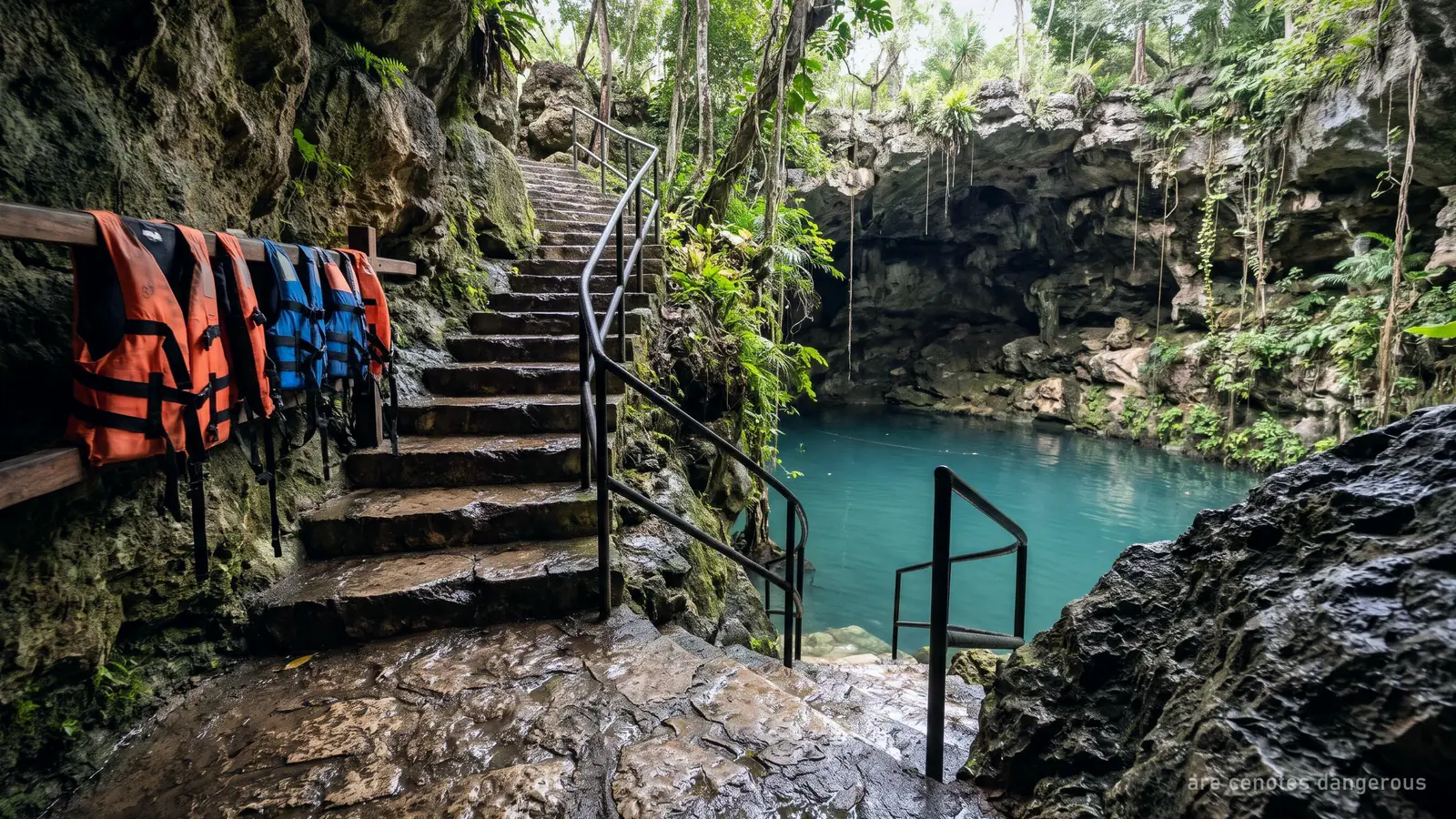
Are cenotes dangerous to swim in?
Updated October 27, 2026
Quick answer
A cenote is a deep pool in a limestone pit, so the risks are deep water, slippery steps, rock edges and, for divers, overhead caves. Yucatán's cenote regulation (Decree 193/2014) requires at least one lifeguard at every swimming cenote and life jackets for rent, and it bans running and jumping. People have died: in September 2023 a US tourist drowned at Cenote Azul after diving in from the edge and hitting a rock, Diario de Yucatán reported.
The rules depend on the state. Yucatán, home to Chichén Itzá, Ik Kil and the Valladolid cenotes, has a written cenote regulation. We found no Quintana Roo equivalent for the cenotes near Cancún, Puerto Morelos, Playa del Carmen and Tulum, where each park sets its own rules. Por Esto (March 2026) reports that several Quintana Roo cenotes make a life jacket mandatory even for people who can swim, especially the deep and semi-open ones. This page repeats what the sources say; it is not medical or legal advice.
Depth and life jackets
Cenotes are deeper than they look from the platform. Ik Kil is about 48 m (157 ft) deep and Zací reaches about 100 m in its deepest part (Wikipedia). Article 19 of Yucatán's Decree 193/2014 says owners of swimming cenotes must keep at least one lifeguard on duty while open and rent enough life jackets for their capacity. Yucatán Today goes further and says wearing one is mandatory by law in every Yucatán cenote; the decree text we read requires the rental service, not that every visitor wears one. In Quintana Roo it varies: a Dos Ojos guide says life jackets are mandatory there, while a guide to Calavera says they are not compulsory at that cenote.
- Ik Kil — The 240-peso (MXN) ticket includes a life vest, per the park's own site.
- Dos Ojos — Life jacket mandatory for safety reasons; the 350-peso basic entry includes one (2024 and 2026 guides).
- Tours — The swim day at El Retoño, the Tulum and Cenote Mariposa day and the turtle and cenote tour all list life jackets as included.
Slippery steps, ledges and jumps
Many cenotes are reached by stairs cut into the rock or a tunnel: Ik Kil, Suytun and Zací all have them (Wikipedia; Yucatán state tourism). A Tulum guide (October 2026) recommends water shoes for Calavera's slick limestone steps. Yucatán's decree bans running and jumping inside cenotes, caves and grottoes (art. 6), along with entering under the influence of alcohol or drugs. Quintana Roo parks often build jump platforms instead: Cenote Azul has a natural ledge about 4 m high over its deepest water, and Las Mojarras a 6 m platform. The 2023 death at Cenote Azul happened when a visitor dove from the edge, struck his head on a rock, lost consciousness and drowned (Diario de Yucatán, 17 September 2023).
Water quality
The water is groundwater from a karst aquifer that researchers describe as highly vulnerable to contamination because the rock is permeable and the water table shallow (Perera-Burgos et al., 2024). Studies cited by Por Esto (August 2026) put 71% of the Yucatán aquifer at high to extreme vulnerability, and a biologist quoted by Por Esto in 2025 said 80% of the Quintana Roo cenotes his groups explored show contamination, without citing a study. Yucatán's decree bans tourist use of cenotes with high contamination or toxicity (art. 20). We found no health-authority data on illness among swimmers. The shower-first and no-sunscreen rules protect the water, and the what to wear page covers them.
Caves, diving and wildlife
Swimming and snorkelling stay in the daylight zone. Diving is where the serious risk sits.
- Cavern vs cave — Cavern diving stays where the exit is visible by daylight; cave diving goes beyond it and is technical diving with guidelines, redundant lights and gas planning (Wikipedia). Only certified cave divers go past the light zone. Running out of gas after getting lost is the most common cause of cave-diving deaths in Sheck Exley's analysis.
- Who sets the cavern rule — PADI's Cavern Diver course needs Advanced Open Water and age 18. For guided cavern dives, Mexidivers asks for Open Water at Dos Ojos, and Agua Clara Diving asks for Advanced Open Water for The Pit and Dos Ojos. See cenote diving.
- Wildlife — Casa Cenote has a resident crocodile known as Panchito (2024 guide) and Cenote Encantado a small one (2024 guide). Dos Ojos has a bat cave, and its fish are mostly under 10 cm. We found no reputable report of eel attacks.
Book a guided swim
A guide does not remove the risks, but it handles the gear and the briefing. Yucatán's decree requires guides to be trained in first aid and to instruct visitors on protective equipment (art. 18). The El Retoño swim day opens with a safety talk and includes a life jacket; Rio Secreto supplies wetsuit, life jacket, helmet and lamp, runs groups of up to 15 per its listing, and asks that guests can float. Compare guided cenote tours from Cancún, or start with a cenote swim from Cancún.
Frequently asked questions
Is it safe to swim in a cenote if you can't swim?
Wear the life jacket. Yucatán's decree requires swimming cenotes to rent them, Ik Kil includes one in its ticket, and several Quintana Roo cenotes make them mandatory. Rio Secreto says guests do not need to swim but must be able to float.
Why do cenotes close at 5?
Most posted hours end around then: Ik Kil 9:00 to 17:00, Dos Ojos 8:00 to 17:00, and Chichén Itzá stops entry at 16:00. None of the sources we read gives a reason. Plan to be in the water well before closing.
Are there crocodiles in cenotes?
Two are documented in 2024 guides: Panchito at Casa Cenote and a small one at Cenote Encantado, both near Tulum. We found no official wildlife source on crocodiles in other swimming cenotes.
Can cenotes make you sick?
We found no health-authority data on illness among swimmers. Studies cited by Por Esto (August 2026) find much of the Yucatán aquifer vulnerable to contamination, and Yucatán bars tourist use of cenotes with high contamination.
Can anyone dive in a cenote?
Snorkelling, yes. Guided cavern dives need at least Open Water at some dive centres and Advanced Open Water at others. Going beyond the daylight zone needs cave certification.
Sources