
informational 7 min read
Cenote Swimming and Snorkelling: What It Is Like, and the Rules
Updated October 27, 2026
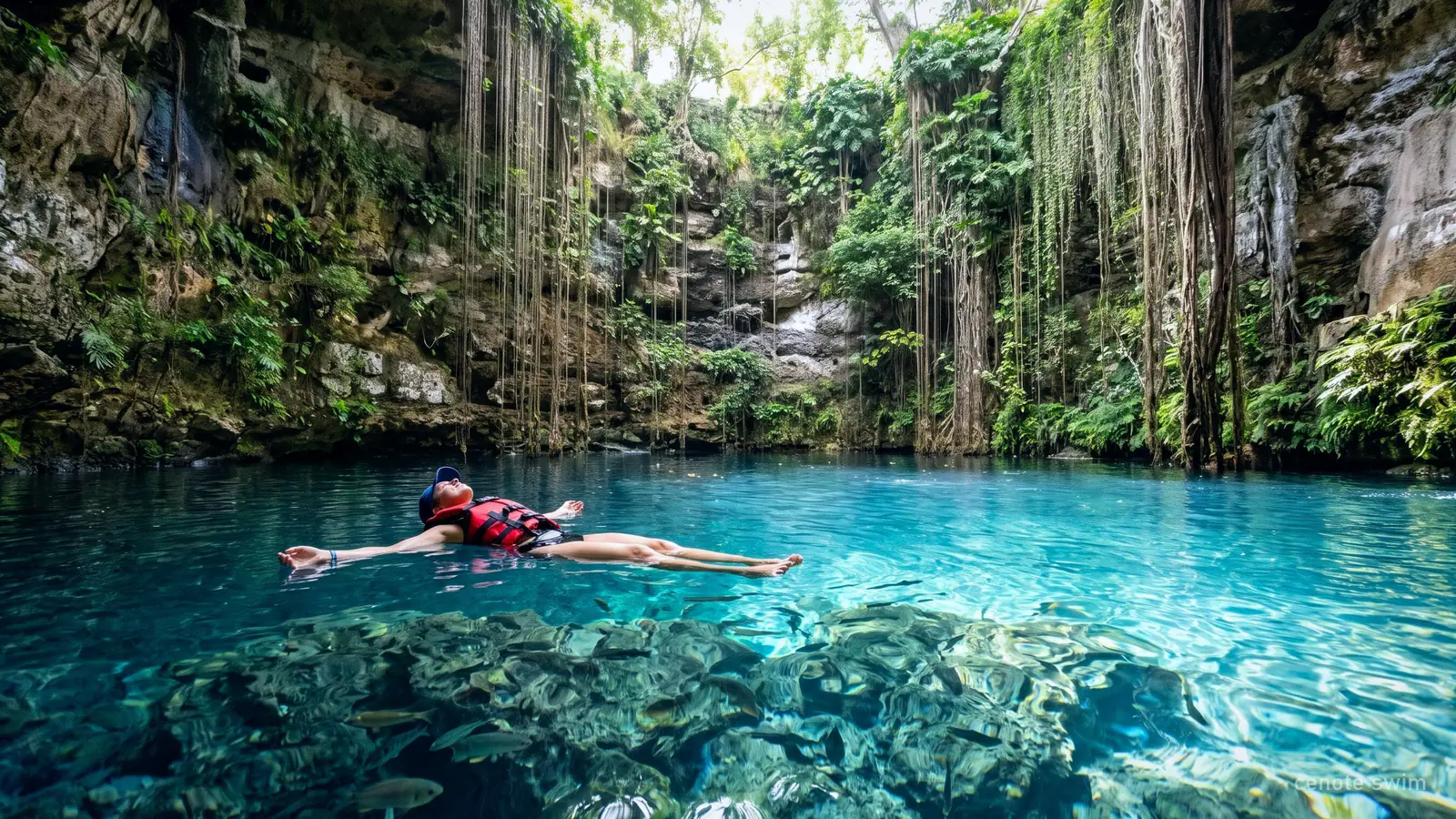
A cenote swim is a dip in a natural sinkhole full of fresh groundwater: cool water of about 24 to 25 °C (75 to 77 °F), clear enough to see the bottom or the cave roof, and often deep enough that you swim in a life jacket. Most cenotes ask you to shower first and skip sunscreen. You can snorkel in most of them with a mask, and see fish, roots, rock and light shafts rather than coral. From Cancún, the easiest way in is a swim day with transport, or a drive down the Ruta de los Cenotes.
What the water is like
Cenote water is fresh, not salty, at least near the surface. It is rain that has filtered slowly through limestone, which is why Wikipedia’s cenote article says it is often transparent: there is little in it to cloud it. Wikipedia’s Dos Ojos page adds that visibility there is limited more by light than by the water itself.
The temperature hardly changes through the year. Wikipedia gives about 25 °C (77 °F) at Dos Ojos. Yucatan Today says Yucatán cenotes stay no higher than 24 °C (75 °F). A 2015 university study measured 24.7 °C in a cenote system on Cozumel. That feels cool after the beach. Our page on whether cenotes are cold has more.
Depth varies a lot. The snorkel area at Dos Ojos reaches about 10 m (33 ft), per one Tulum guide. Ik Kil, near Chichén Itzá, is about 48 m (157 ft) deep per Wikipedia, with the water surface about 26 m below the ground. Some cenotes are open pools under the sky, others are caverns lit by a hole in the roof. The what is a cenote guide explains the types.
Life jackets
Expect to wear one. The rule depends on the cenote, and the sources do not all agree.
- Yucatán state (Chichén Itzá, Valladolid): Decree 193/2014, article 19, says cenotes used for swimming must have at least one lifeguard on duty and a life-jacket rental service. Yucatan Today goes further and says wearing one is mandatory in every Yucatán cenote.
- Ik Kil: its own site says the life vest is mandatory and included in the 240-peso (MXN) adult ticket, with a locker and parking. Lifeguards supervise.
- Quintana Roo (Cancún, Tulum): Por Esto reported in March 2026 that several cenotes require a life jacket even for strong swimmers, especially deep or semi-open ones, and that some charge extra for it.
- Dos Ojos: a Tulum guide says life jackets are mandatory for everyone.
- Calavera (Tulum): one guide says a life jacket is not compulsory there.
Do you need to know how to swim? The sources do not set a rule. With a life jacket, people who swim weakly do visit cenotes. Rio Secreto, a guided cave river, says you do not need to swim but must be able to float.
The shower and sunscreen rule
This is the rule most visitors get wrong. Sunscreen, repellent and lotions wash off into water that is also the region’s drinking supply.
- Yucatán Decree 193/2014, article 6: no tanning lotions, soaps or similar products within at least three hours before entering, except organic biodegradable products at swimming cenotes. You must shower before entering.
- Por Esto (March 2026): most cenotes ban traditional sunscreen, repellent and body creams; if you use sunscreen, it should be 100% biodegradable and applied well ahead.
- Dos Ojos guide (2024): no creams, sprays or protectors before entering, even eco-friendly ones.
- Gran Cenote: you must shower first, and sunscreen and repellent are not allowed before you swim, per a 2025 guide.
The safe approach: arrive without sunscreen on, shower at the cenote, and put protection on after your swim. The what to wear to a cenote page covers clothes and shoes.
The Yucatán decree also bans running and jumping inside cenotes, caves and grottoes, along with alcohol, smoking, food and litter. Quintana Roo has no equivalent rule that we found, and some parks there have jump platforms. In September 2023 a US tourist died at Cenote Azul, south of Playa del Carmen, after hitting his head on a rock while diving in from the edge, Diario de Yucatán reported. Our page on whether cenotes are dangerous has more.
Snorkel gear
A mask is worth it. Underwater you see tree roots, rock formations, small fish and the light coming through the roof. Turtles live in Gran Cenote, per two Tulum guides, and visitors are asked to keep their distance. Wikipedia says the fish at Dos Ojos are mostly well under 10 cm long, with at least two kinds of freshwater shrimp. No source we read reports sharks.
Gear is rented at the bigger cenotes, and rental prices vary between sources:
| Cenote | Entry | Snorkel gear | Source and date |
|---|---|---|---|
| Ik Kil | 240 pesos, life vest included | Not listed | cenoteikkil.com (official) |
| Dos Ojos | 350 to 500 pesos in 2026 reports | 100 to 200 pesos in 2026 reports | Tulum guides, Oct 2026 |
| Gran Cenote | about 500 pesos (2025 to 2026 reports) | Rented on site | Tulum guides |
| Casa Cenote | about 150 pesos, life jacket included | about 20 USD (2024) | Tulum guides |
| Zapote | Not published | Bring your own | cenoteszapote.com |
Bring cash in pesos. Por Esto says not every cenote has a card terminal or signal, and that entry fees run from 100 to more than 300 pesos. The full fees table is on how much it costs to go to a cenote.
Can you get sick from the water?
We can only report what the sources say. A 2024 study in the journal Water describes the Yucatán aquifer as highly vulnerable to contamination because the rock is permeable and the water table is shallow. Por Esto reported in August 2026 that only 2.7% of wastewater in Yucatán is treated before returning to the ground. A biologist quoted by Por Esto in 2025 said 80% of Quintana Roo cenotes explored by biologists showed contamination, with no study cited. We found no official health warning for any named swimming cenote. The shower rule exists to keep the water clean.
When to go
Early. Por Esto advises arriving between 8:00 and 10:00 a.m. to avoid queues. For Gran Cenote, one Tulum guide says to go at the 8 a.m. opening, and another says parking is limited and fills by mid-morning. A third gives its last entry as 4:15 p.m. in a January 2025 update.
The water temperature barely changes through the year, per the sources above, so the season matters less in the water than on the beach.
You can visit many cenotes on your own by car or colectivo, paying the gate fee in cash. A tour adds transport and often lunch and the life jacket. Our page on whether you can visit cenotes without a tour compares the two.
Book a swim
From Cancún, the simplest option is a cenote swim tour from Cancún: a day at Cenotes El Retoño, a private club with two natural cenotes, a pool and bikes, from $59 with transport from a Cancún meeting point, lunch and a life jacket. It is rated 4.9 on 75 reviews of this tour on GetYourGuide, with free cancellation up to 24 hours before and reserve now, pay later. For other ways to swim, from Chichén Itzá days with a cenote swim to Tulum and Akumal trips, see all cenote tours from Cancún.
Frequently asked questions
What is a cenote swim?
A swim in a natural sinkhole filled with fresh groundwater. You enter by stairs or a platform, usually in a life jacket, and swim or snorkel in cool, clear water under rock walls, roots or a cave roof.
Do you have to wear a life jacket in a cenote?
At many cenotes, yes. Ik Kil's own site and a Dos Ojos guide both say it is mandatory, and Por Esto reported in March 2026 that several Quintana Roo cenotes require one even for swimmers. A few, such as Cenote Calavera per one Tulum guide, do not.
Can you wear sunscreen in a cenote?
Most cenotes say no. Yucatán's Decree 193/2014 bans lotions and soaps within three hours before entry, except organic biodegradable products at swimming cenotes. A Dos Ojos guide says not even eco-friendly products before you swim.
Do I need to be able to swim?
Not at every site, but you must be comfortable in deep water. Life jackets are rented or included at most swimming cenotes, and Rio Secreto says guests do not need to swim but must be able to float.
Are there sharks in cenotes?
No source we read reports sharks. Wikipedia's Dos Ojos page says the fish there are mostly well under 10 cm long, with at least two kinds of freshwater shrimp.
How cold is the water?
Cool, not cold. Wikipedia gives about 25 °C (77 °F) all year at Dos Ojos, and a Yucatán guide says no higher than 24 °C (75 °F).
Sources